Technology
How TI-SKIN® works
Aluminium and salt: a film that turns heat away and a mineral core that stores it. The patented system that does not resist the heat flow, it intercepts it.
Aluminium and salt: a film that turns heat away and a mineral core that stores it. The patented system that does not resist the heat flow, it intercepts it.
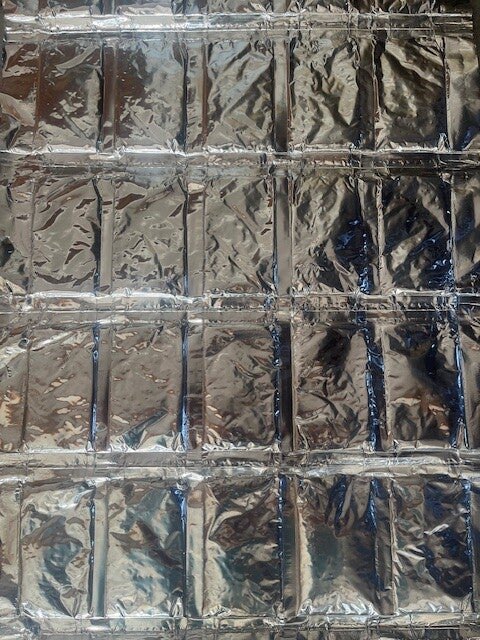
A patented aluminium-polymer film with high reflectivity and low emissivity: it sends back 97% of thermal radiation in the near infrared, with emissivity 0.03. The foils create closed reflective air spaces perpendicular to the flow: high-performance reflective insulation, even before the core comes into play.
Hydrated inorganic salts, macro-encapsulated in the film. They melt at the chosen temperature (18, 23, 28 °C for comfort; −20, −23 °C for cold) and in that transition they absorb energy without rising in temperature; solidifying again they give it back and "recharge" for the next cycle. Incombustible, non-toxic, hydrophobic, with high latent energy.
The temperature measured on the roof at the afternoon peak. The reflective mat sends most of the radiation back.
The heat that passes is absorbed by the core, which behaves like a thermal battery: 4-6 hour time shift, peak levelled.
At night the core discharges at constant temperature, using the thermal inversion or a light ventilation. The next morning it starts again.
Heat always goes from hot to cold, faster the greater the temperature difference. Traditional insulation puts a resistance on the path, the R-value: fibreglass, cellulose, petroleum-derived foams. More resistance means more thickness.
TI-SKIN does something else: it intercepts the heat and converts it into latent energy, used to change the physical state of the core. That is why it has no fixed R-value: during the transition the resistance tends to infinity, and zero-flow conditions have been measured even with large temperature differences. It is the figure to keep in mind in calculations, and the reason why design goes through dynamic simulation.
| Existing insulation | Alone | With TI-SKIN |
|---|---|---|
| R2 insulation | 2 | 17 |
| R4 insulation | 4 | 35 |
| R6 insulation | 6 | 52 |
Attic test: roof 65 °C / 19 °C, accepted indoor 26 °C, 28 °C panel at 4 kg/m². Test results reflect realistic performance under test conditions; in real conditions performance follows the behaviour of the materials.
| Line | Models | Core works at | Latent energy | Where |
|---|---|---|---|---|
| TI-SKIN Comfort | 18 · 23 · 28 | 18 / 23 / 28 °C | 170 J/g | Homes, offices, hospitality, schools, healthcare, industrial buildings, roofs |
| TI-SKIN Cold | −20 · −23 | −20 / −23 °C | 250 J/g | Cold rooms and warehouses, transport, pharmaceuticals |
| TI-SKIN Heat coming soon | 48 | 48 °C | — | Process heat, hot water, dryers |
| TI-SKIN Marine | Marine | to specification | — | Cabins, hulls and partitions of ships and yachts: lightweight, marine certifications |
Standard format 48 × 122 cm, thickness 1.2 cm, 4.8 kg/m²; other weights for specific cases. For special projects the bulk core mixtures are available, from 3.5-litre containers to 1,000-litre tanks, on advice of the technical office.
Very limited contribution to fire, absent or negligible smoke, no burning droplets: this is the EN 13501-1 classification obtained in the tests of Istituto Giordano. Ignition time 0.10 minutes, maximum spread 41 cm, flame-spread and smoke indices of 5. Thermal tests (conductivity, specific heat, reflectance and emissivity) by Certimac (ENEA-CNR). ACCREDIA-accredited laboratories.
Inorganic cores do not burn, unlike the paraffins of organic PCMs, and do not suffer the photochemical degradation of plastic materials exposed to the sun.
In the environmental screening carried out within the Solar Impulse Efficient Solution label, on 200 m² over 25 years, TI-SKIN shows an environmental footprint about 50% lower than mineral wool, better in every phase of the life cycle. The panel is removed and reused, contains no petroleum derivatives and generates no special waste at end of life.
One square metre installed can avoid, under the conditions considered, about 25 kg of CO₂ a year: a benefit equivalent to the annual absorption of a mature tree. One hundred square metres, about 2,500 kg of CO₂ a year.
The full series is on the Documents page. Price list and terms of supply on request.
Every building and every process has its own configuration. Tell us about yours: we reply with a first technical assessment, no strings attached.